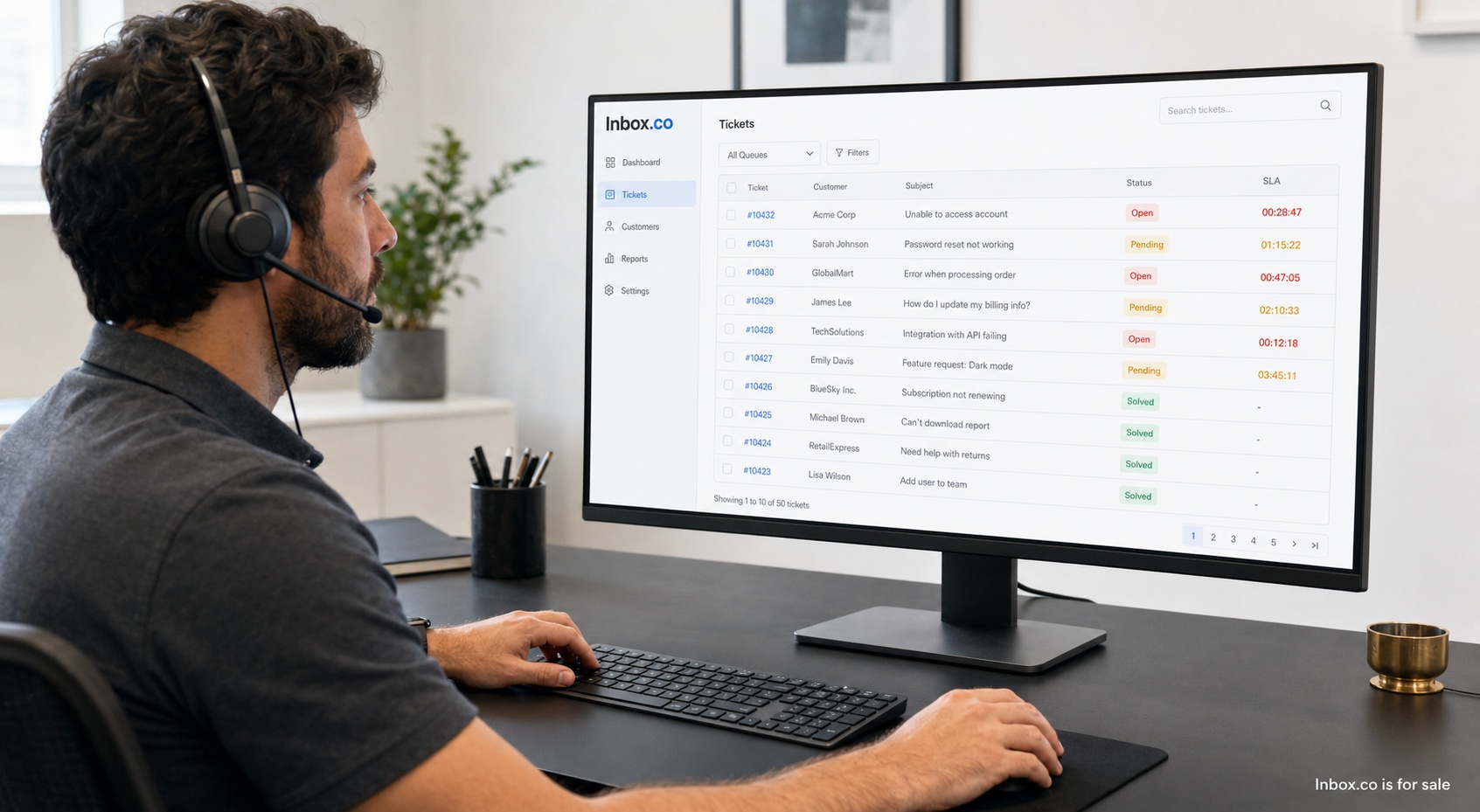
A shared inbox and a help desk can both turn incoming email into team-owned work. The difference is usually one of operating model, depth, and audience. A shared inbox keeps the conversation close to email and adds assignment, notes, collision detection, and basic reporting. A help desk treats each request as a managed case inside a broader service operation.
Neither model is automatically more professional. A small team can deliver excellent support from a focused shared inbox. A large organization can use a sophisticated help desk poorly. The useful question is how much structure the work requires and whether the team will maintain that structure.
What a shared inbox does well
A shared inbox is strong when customers prefer email, the team is relatively small, and most requests can be resolved by the people reading them. Products such as Front illustrate this collaborative model. Teammates can see ownership, avoid duplicate drafts, ask internal questions, and close completed threads.
Setup is usually quicker. A company connects an existing address, invites teammates, and defines a few views or tags. People can become productive without learning a detailed ticket taxonomy. That simplicity can improve adoption, especially when sales, billing, partnerships, and support all share the same tool.
The limitation appears when workflows branch. If different request types have distinct service targets, approval paths, entitlements, escalation groups, and reporting obligations, a lightweight inbox may accumulate workarounds. Tags begin to imitate fields, reminders imitate automation, and manual spreadsheets fill reporting gaps.
What a help desk adds
A help desk usually provides formal ticket states, custom fields, service agreements, queues, escalation rules, customer portals, knowledge bases, and deeper workforce reporting. Products such as Freshdesk and Salesforce Service illustrate the broader service-desk model. The ticket becomes a durable unit that can move through a defined service process.
This structure helps when a request requires several teams, regulated evidence, or repeated approvals. It can also support self-service and consistent intake. A well-designed form gathers product, account, severity, and environment details before an agent begins, which can shorten resolution.
The cost is administrative weight. Fields, automations, roles, macros, service policies, and integrations need owners. Poorly maintained rules route tickets incorrectly or hide them in edge-case queues. Agents may spend more time satisfying the system than understanding the customer.
Use complexity as a threshold
Choose a shared inbox when the main problems are invisible ownership, duplicate replies, internal coordination, and basic visibility into waiting messages. Choose a help desk when the work already has formal categories, entitlements, service levels, cross-team escalation, multiple channels, or compliance requirements that need a structured record.
Volume alone is not decisive. A high-volume team with simple, repetitive email may work well in a shared inbox supported by careful routing. A lower-volume team handling security incidents or regulated claims may need a help desk because each case has complex evidence and approvals.
Count exceptions. If a pilot repeatedly needs side documents, special tags, manual timers, and manager memory, the lighter tool may be below the threshold. If a help-desk pilot requires most fields to be marked optional and agents avoid the portal, the heavier tool may be above it.
Compare the customer experience
Customers often experience a shared inbox as normal email. They can reply naturally, include colleagues, and retain a familiar thread. That works well for relationship-oriented service. Make sure assignments and internal notes never leak into the outgoing conversation and that changes in agents do not produce confusing signatures.
A help desk may expose ticket numbers, portals, forms, and automated status notices. These can be valuable when customers need to track many requests or provide structured data. They can feel bureaucratic when someone has a simple question. The goal is not to hide process but to ask the customer for only the structure that improves the answer.
Test accessibility in both agent and customer experiences. The standards and guidance at Section508.gov provide a practical reference for accessible technology. A portal that creates barriers is not an upgrade over email.
Consider data, security, and integrations
Both systems hold sensitive communications. Review authentication, roles, private groups, audit events, exports, deletion, retention, and provider access. If customer records appear beside a conversation, confirm that the integration respects the current user’s permissions and shows when data was last refreshed.
A shared inbox often integrates with a CRM, issue tracker, and chat tool. A help desk may become the system of record for service and connect to telephony, identity, product telemetry, and a customer portal. More integrations increase both utility and failure modes. Define which system owns each fact and how conflicts are resolved.
AI features deserve the same scrutiny in either model. Ask what content is processed, which actions can happen automatically, how suggestions are evaluated, and how a person reviews a draft. Incoming messages should be treated as untrusted input, and high-impact account actions should require explicit authority.
A practical decision process
Begin with ten recent conversations that represent ordinary work and five that represent difficult exceptions. Recreate them in each shortlisted system. Assign, collaborate, escalate, search, report, export, and close. Include the people who answer messages and the people who maintain the workflow.
Write down the smallest operating model that solves the real failures. If a shared inbox meets it cleanly, start there. Simplicity preserves attention and makes later migration easier because the team learns its categories through real use. If the model already requires formal case management, choose a help desk and invest in administration from the beginning.
Plan a review after several months. Customer mix, team size, channels, and obligations change. A shared inbox can evolve toward a help desk, and an overbuilt help desk can be simplified. The choice is not a statement about company maturity. It is a decision about the right amount of structure for today’s work.
The best system makes it easier to see who is waiting, who owns the response, and what a good resolution requires. Everything else should justify the burden it adds.